Polymesh vs Corda Which Blockchain Handles Regulated Assets Better in 2026
Real-world asset (RWA) tokenization has left the lab and entered production. Banks, exchanges, and fintechs are already moving bonds, funds, and real-estate positions onto regulator-approved ledgers—most notably Polymesh’s public-permissioned chain and R3’s enterprise Corda network. Together, these platforms safeguard more than $10 billion on-chain, and Corda alone records over one million transactions every day. In this guide, we compare Polymesh and Corda on identity, compliance, privacy, speed, and ecosystem strength so you can choose the right rails for regulated assets in 2026.
Background: Polymesh and Corda at a glance
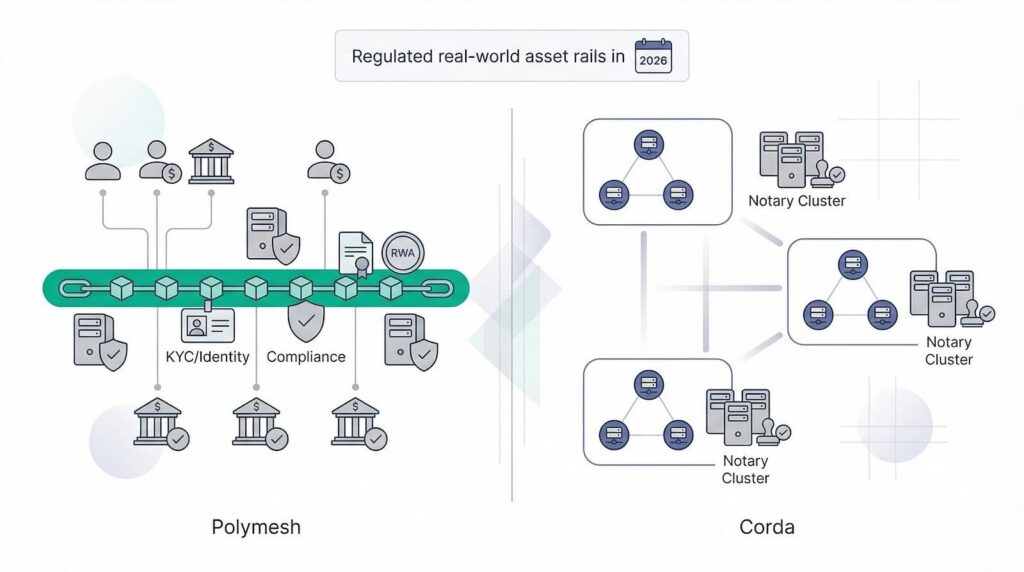
High-level overview of how Polymesh and Corda structure networks for regulated real-world assets in 2026.
Polymesh. The public-permissioned mainnet launched on October 28, 2021 as the first layer 1 focused on regulated securities. Validators are KYC-verified financial institutions, and the native POLYX token covers fees, staking, and on-chain governance.
Corda. According to Coindesk, R3 released Corda 1.0 in October 2017 after working with a consortium of more than 100 banks. Each node maps to a named legal entity, data stays with the transacting parties, and a notary service signs for finality, so no cryptocurrency or global ledger is needed.
The two platforms take different paths from these roots. Polymesh gathers issuers and investors on one shared rail, while Corda supports many custom networks within a common framework. We will compare their approaches to identity, privacy, and scalability in the sections ahead.
Built-in identity: two very different playbooks
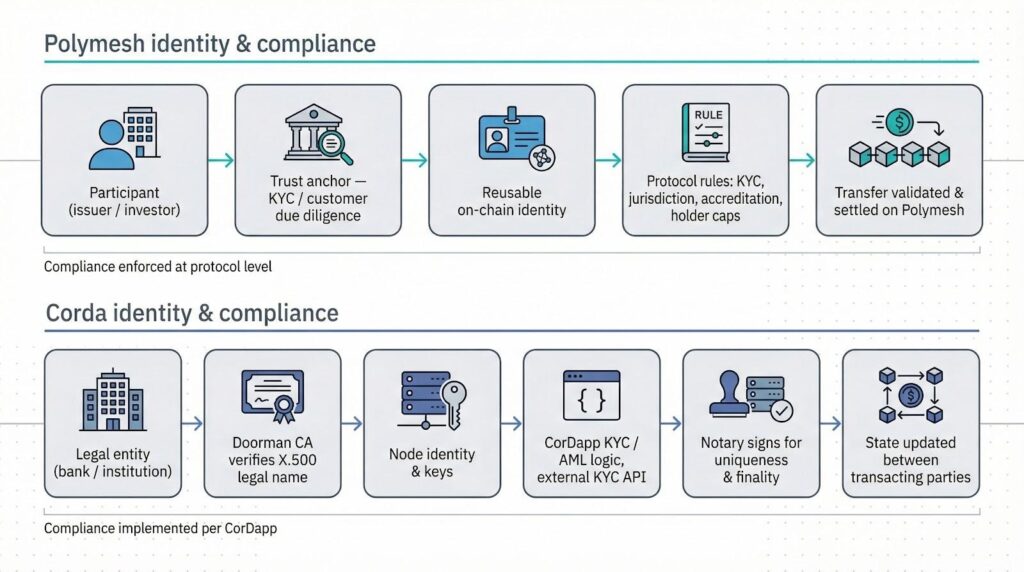
Polymesh. Each participant completes customer due diligence with a regulated trust anchor. After approval, the chain issues a reusable on-chain identity. The protocol checks that identity on every transfer, along with issuer rules such as accreditation or jurisdiction blocks. Compliance becomes part of settlement itself.
Corda. Corda documentation explains that a node can join a network only after a “doorman” certificate authority verifies its legal X.500 name. That identity lives inside the node’s keys and travels with every transaction. Individual CorDapps may add their own KYC or AML logic, so one network can require strict screening while another keeps the bar lower.
In short, Polymesh enforces identity within the protocol, while Corda supplies the plumbing and leaves enforcement to the application builder.
Compliance logic: automatic guardrails or build-your-own?
Polymesh. The Polymesh developer portal notes that asset issuers set transfer rules—holder caps, jurisdiction blocks, accreditation checks—directly in the protocol. Each transfer runs through those rules in real time, and the chain rejects any that fail before finality.
Polymesh’s compliance documentation describes how issuers combine identity claims such as KYC, accreditation and jurisdiction into rule sets, for example allowing a transfer only if the receiver is KYC verified and outside a restricted jurisdiction or is both KYC verified and accredited.
Companion guidance on transfer restrictions shows how holder caps and concentration limits are enforced by a statistics module at the protocol level instead of bespoke application code, giving compliance teams a concrete model they can test against their internal policies.
Corda. The open-source Token SDK provides templates, but every CorDapp codes its own checks. Developers call an external KYC API, verify signatures, and then request a notary stamp for finality. This flexibility helps teams match niche regulations, yet it also adds code reviews and legal approvals.
In short, Polymesh bakes compliance into the infrastructure, while Corda leaves it in your application code.
Network architecture and governance
Ledger design
Polymesh. All transactions land on one public-permissioned chain. Anyone can verify the history, but only KYC-verified validators create blocks, a model Crynet calls “controlled block production.”
Corda. There is no global ledger. Each transaction forms a mini-ledger shared only by the parties involved, and a notary cluster signs to guarantee uniqueness. Business networks choose the notary they trust or run their own.
Governance
Polymesh. Protocol upgrades flow through on-chain Polymesh Improvement Proposals (PIPs). Any POLYX holder can submit a PIP, but a seven-member Governing Council must ratify it, which keeps upgrades fork-free and regulator friendly.
Corda. Governance is off-chain and network specific. The Corda Network Foundation manages baseline parameters, while each business network writes its own charter that covers membership, upgrade cadence, and notary policies.
In short, Polymesh centralizes activity on a single, governed rail, while Corda offers a federated model where each consortium sets its own rules.
Ledger model: one public chain vs private channels
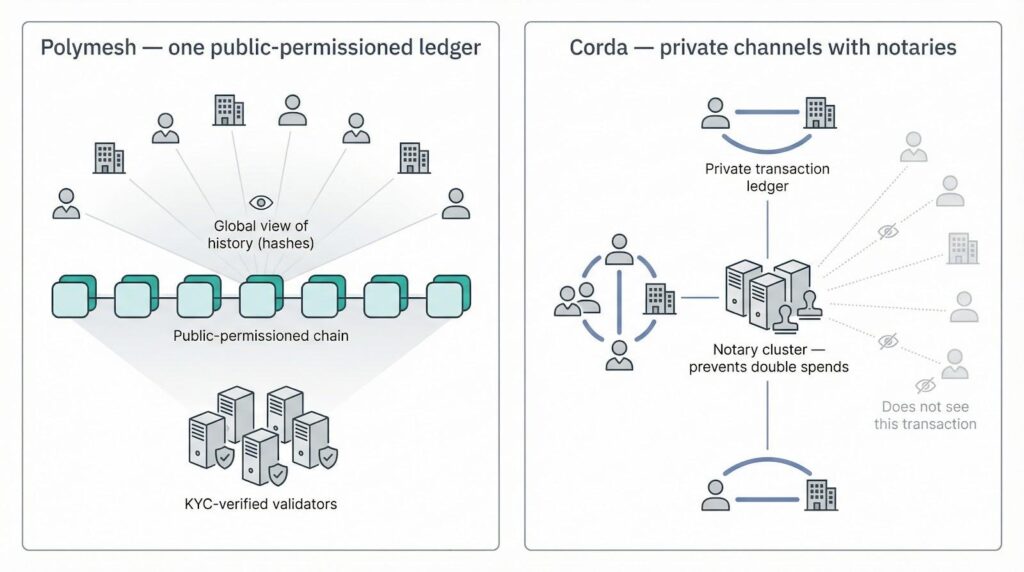
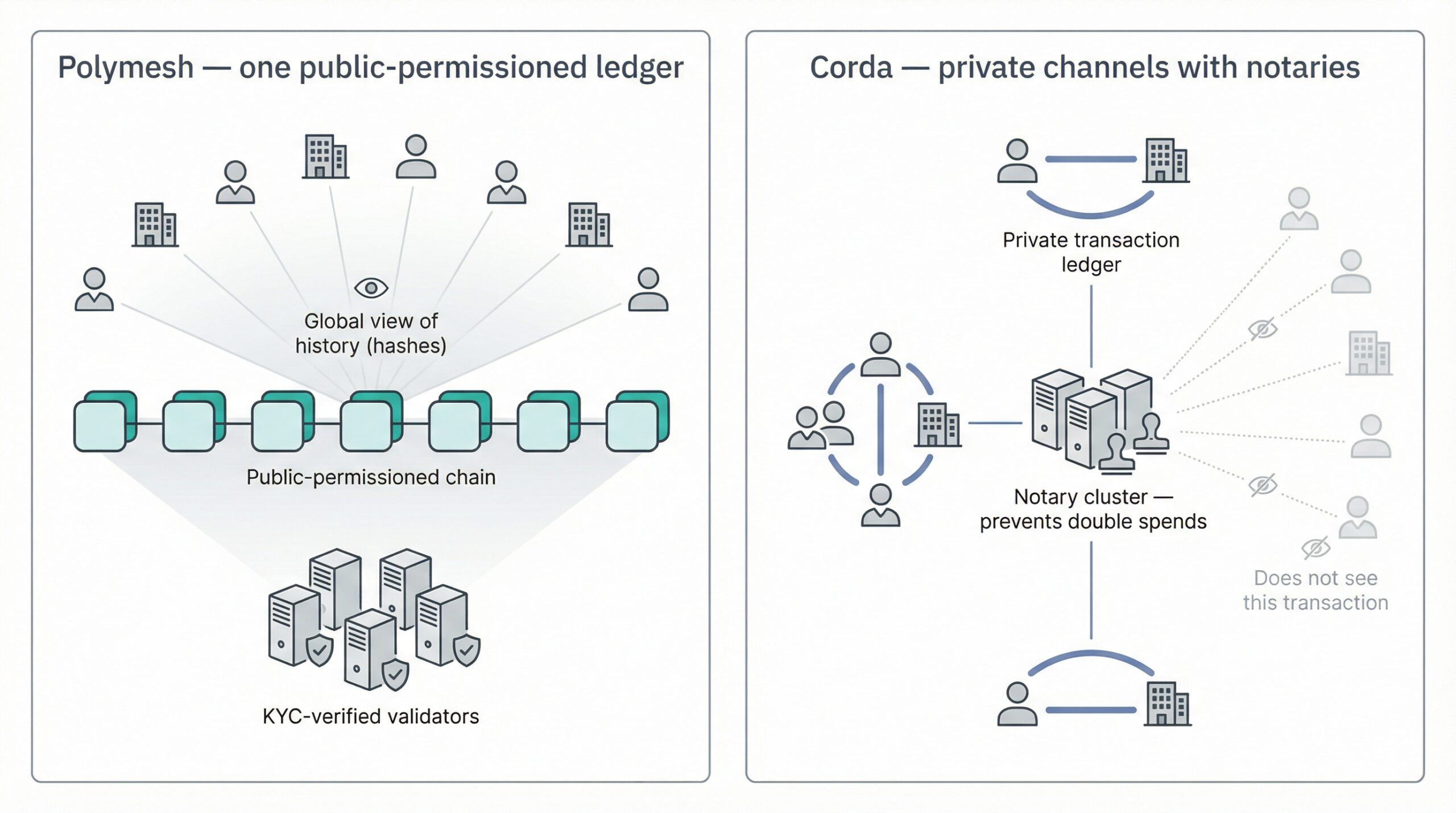
Polymesh puts all activity on one auditable chain, while Corda routes transactions through private ledgers and notary clusters.
Polymesh. All transactions post to a single public-permissioned ledger. Anyone can view hashes, but only KYC-verified validators add blocks. This structure provides global auditability without anonymous miners.
Corda. The platform maintains no shared chain. Each transaction forms a private ledger among the parties, and a notary signs to prevent double spends; other nodes never see the data. The benefit is targeted privacy, though networks must bridge silos to pool liquidity.
In short, Polymesh gives every asset the same stage, while Corda lets each consortium build its own room.
Asset functionality and smart-contract approach
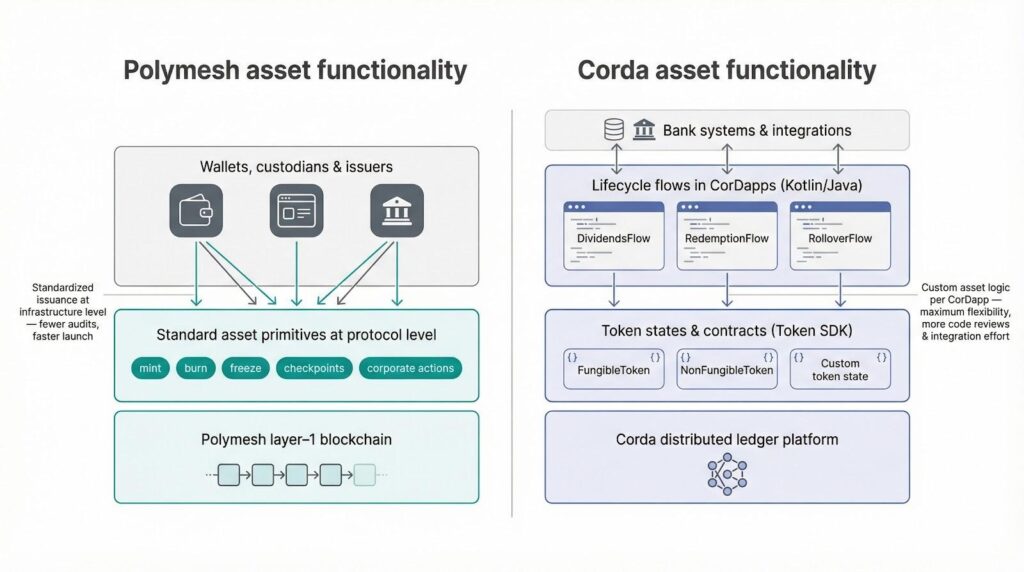
Polymesh. Issuers create assets with built-in primitives such as mint, burn, freeze, checkpoints, and corporate actions by calling protocol functions, so no custom contract is required. Because these controls sit at layer one, every wallet and custodian uses the same commands, which trims audits and launch time.
Polymesh estimates that as much as $800 trillion in traditional assets could move on-chain, and issuers are already “tokenizing RWA’s with Polymesh“ across equity, debt, real estate, and carbon credits.
Corda. Assets live as states inside CorDapps. With the open-source Token SDK, developers model a FungibleToken or NonFungibleToken, program lifecycle flows in Kotlin or Java, and decide how events like dividends or early redemptions run. The method mirrors existing processes yet adds code reviews and integration effort.
In short, Polymesh provides standardized issuance at the infrastructure level, while Corda lets you design logic from scratch.
Privacy and confidentiality
Polymesh. Transactions post to the public ledger, yet asset amounts and counter-party details can be encrypted with the MERCAT framework. In Polymesh Private deployments, Confidential Assets store balances using Twisted ElGamal homomorphic encryption. Validators prove each transfer without seeing amounts, and issuers can give auditors decryption keys when needed.
Corda. Privacy starts with the network design. Only the transacting parties and the selected notary receive the payload. With a non-validating notary, the service views only state references and metadata while still guaranteeing uniqueness and time-window checks.
In short, Polymesh keeps one shared source of truth and masks sensitive fields with cryptography, while Corda maintains privacy by limiting who sees the data.
Performance and scalability
Polymesh. A permissioned group of more than 50 KYC-verified validators seals blocks in about six seconds and sustains over 150 transactions per second in public benchmarks. Because the runtime focuses on asset transfers, it avoids the random compute load that slows general-purpose chains.
Corda. With no global ledger, workloads run in parallel. One live network from HQLAx and its banking partners handles more than one million transactions per day, and teams can add more notary clusters to lift capacity further.
Latency is similar on both sides. Polymesh offers deterministic finality once a block seals, while Corda delivers it the moment the notary signs. Scaling paths differ: Polymesh can raise validator counts or add sharding in future releases, whereas Corda grows horizontally by spinning up new notary pools and keeping data local.
Both platforms already meet sub-second trade matching and same-block settlement. Your choice is whether you want a single asset-specific highway or a network of private roads that can grow on demand.
Ecosystem, adoption and support
Enterprise credibility often hinges on who is already live, and you want to see real assets moving.
Corda. The platform powers SIX Digital Exchange, the HQLAx collateral mobility network, and wholesale CBDC pilots in the EU, UK, and Australia. Across these and other business networks, more than ten billion dollars in tokenised real-world assets now settle on Corda, and live networks process over one million transactions each day. R3’s marketplace lists more than 200 partner CorDapps plus a global bench of Java integrators, giving banks an off-the-shelf talent pool.
Polymesh. Specialist providers keep joining the public-permissioned chain. DigiShares moved 150 real-estate issuers onto Polymesh in 2024, and Fireblocks added native POLYX custody in early 2025, removing a key operational hurdle. The Polymesh Association funds SDKs in TypeScript and Rust and has financed more than 40 integrations, from exchange connectors to on-chain analytics.
Tooling support exists on both sides. R3 offers commercial SLAs and cloud images for Corda 5, while Polymesh’s open-source SDKs let startups launch without licence fees. Corda appeals to large integrators, whereas Polymesh rallies a focused community around one compliance-first public network.
Developer experience and integration
Polymesh. The open-source TypeScript / JavaScript SDK wraps high-level calls such as createAsset(), setComplianceRules(), and distributeDividends(), so your web team can tokenise and manage assets without writing smart contracts or running a node. REST endpoints and a Substrate RPC slot easily into exchange or custody stacks, and you pay only network fees in POLYX.
Corda. Developers write JVM code (Kotlin or Java) packaged as CorDapps with Gradle, then model State, Contract, and Flow classes. The Token SDK supplies building blocks, yet every lifecycle step—dividends, rollovers, partial redemptions—must be coded, tested, and signed. Nodes connect directly to in-house databases or message buses, but each participant maintains its own infrastructure and handles upgrades.
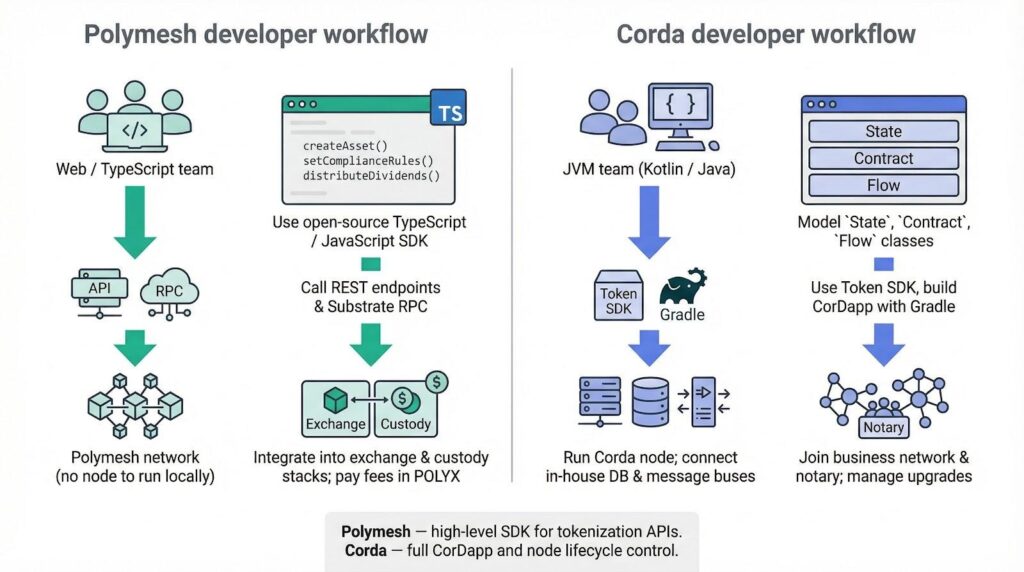
The trade-off is clear: Polymesh gives you a ready-to-use API that trims build time, while Corda rewards deeper engineering effort with custom workflows and local control.
Costs, governance and future direction
Polymesh. You pay a small network fee, often fractions of a cent in POLYX, for every transaction; registering a unique ticker currently costs twenty-five POLYX. Validators collect those fees, and protocol changes move through on-chain Polymesh Improvement Proposals (PIPs) that the seven-member Governing Council ratifies.
Corda. The core platform is open source, but most regulated institutions license Corda Enterprise for support, performance modules, and optional dedicated notary services. Each member runs its own node, so hosting and upgrades sit with the participant. Governance lives off-chain through a business-network charter that defines membership and upgrade rules.
Roadmaps. Polymesh plans Confidential Assets and regional modules aligned with the EU’s DLT Pilot Regime in 2026. R3 is launching a Solana-native Corda Protocol that will let banks pipe yield-bearing RWA positions into DeFi vaults in the first half of 2026.
Conclusion
Quick litmus test. Want a low-friction launch pad with transparent, shared governance? Polymesh fits. Prefer full veto rights and have a budget for custom infrastructure? Corda delivers.
Disclaimer
This article is provided for informational and educational purposes only and does not constitute financial, investment, legal, regulatory, or tax advice. The content reflects publicly available information and the author’s analysis at the time of writing and may not reflect the most current developments.
Nothing in this article should be interpreted as a recommendation, endorsement, or solicitation to use any specific blockchain platform, protocol, token, or financial product, including but not limited to Polymesh, Corda, or POLYX. Readers should conduct their own independent research and consult qualified legal, compliance, and financial professionals before making any decisions involving regulated assets, tokenization, or distributed ledger technology.